Showing posts with label Conflict. Show all posts

Sunday, January 23, 2011

Bethlehem: Church of the Nativity

The Church of the Nativity is just by Bethlehem Square and within sight and earshot of the local mosque. When we arrived, a mullah was behind the microphone calling muslims to prayer over a very effective soundsystem with speakers pointing every direction of the compass up in the minaret.


There's a lot of poverty in Bethlehem. After 9/11 tours to this city, which is so dependent on tourism, stopped. In recent years, they've picked up again, but unemployment is high and the wall doesn't really help facilitate commerce with Israel. Neither does suicide attacks.

When we were in the square a couple of little Palestinian boys tried to pick the pockets of one of the guys in our group, which isn't good advertising for them or their cause. All very sad.

The Church of the Nativity purports to be the place where Jesus was born, and it may well be. After all, we know the "stable" to be a cave not something out a John Wayne Western. So this grotto may well be the place. The star on the right is the "very spot" Jesus was born. Hmmm.


And on the left is the "very place" Jesus' cradle was placed. Hmmm.
The possible birthplace of Jesus was so wrapped up in ritual and even competition from the three church branches that inhabit the Church of the Nativity, that it was all a bit of a downer, though certainly interesting from a purely historical point of view. Again, kind of sad to see the "Christianized magic" that is associated with sacred places and objects. The One who is venerated in this way was so not into that kind of thing.

Bethlehem: Shepherds Abiding in the Fields


Visiting a place like Bethlehem evokes so many different emotions. Just speaking the name brings back memories of candle-light services singing "Silent Night" and "O Little Town of Bethlehem. Memories of kids reading "There were shepherds abiding in the fields keeping watch over their flocks by night." Memories of fireplaces and fun family times.


Seeing the fields where the shepherds hung out and where the angels and the glory of the Lord appeared was pretty amazing, even if they are terraced and covered with trash and surrounded by homes now.


Sadly, we didn't have time to stop of for a coffee at the the Bethlehem Starbuck's, everyone's favorite for a cup of coffee, quality guaranteed. Looks like the head office in Seattle has decided on a bit of a name change, though. Glad they've kept the logo and green colors, though. Hope the coffee isn't green.


Bethlehem is a mix of Christians and Muslims

Bethlehem: The Wall


The city of David, the birthplace of Jesus, is both inspiring and depressing. It's just 5 miles from Jerusalem geographically, but a million miles away in every other respect. The "Love and Peace" slogan outside the entrance to Bethlehem is a nice sentiment, but little more than a dream.


The city is surrounded by a massive security wall to keep suicide bombers in. So far, so good. The U.N. isn't too happy, however, and considers it a violation of the Palestinian's human rights.


It's an ongoing downward spiral where frustration breeds extremism and violence, which is responded to with extremely restrictive measures, which breeds more resentment.


Some of the murals painted on the inside of the wall betray the pain and the mood. This one calls for "Fresh Jewce."


After leaving a Palestinian Christian's shop, we climbed on the bus and queued to get through Checkpoint Charlie or Abdul. While the soldier in the booth was playing Solitaire on a laptop, two soldiers with uzis came on board to make sure Mohammed wasn't hiding under our seats with explosives strapped around his waist.


 In a lighter moment, one of the pastors texted his head deacon right before Sunday services back in the States were about to begin and told him there were soldiers on the bus with submachine guns checking for terrorists. Then his cell phone died and all communications ceased. We're not sure if they will have canceled the service for an intense prayer meeting, or if revival will have broken out.
Published with Blogger-droid v1.6.5

Some Little-Known History on the Dome of the Rock Mosque


When the Israeli Defense Forces took Jerusalem, the following exchange took place between Uzi Narkis, the commanding officer, and Rabbi Goren, a general and the military's chief rabbi:

GOREN: General! General! Now is the time! Do it!
NARKIS: Do what, Rabbi!
GOREN: One hundred explosives. In the Mosque of Omar. That's all we need. That's enough. The whole thing will come down, and once and for all we'll be done with it.
NARKIS: Rabbi, stop.
GOREN: Listen to me, Uzi! If you do this, you will go down in the history of your people!
NARKIS: I've already put my name in Jerusalem's history.
GOREN: Uzi, you don't grasp the meaning of this. This is an opportunity that can be exploited. Now we can do it. Tomorrow it will be impossible.
NARKIS: Rabbi, if you don't stop now, I'm taking you to jail.

[Told by Narkis on his deathbed to a reporter and recorded in a variety of sources. Rich Cohen, Israel is Real, 266.]

Rubble From Roman Destruction of the Temple


How deserted lies the city,
once so full of people!
How like a widow is she,
who once was great among the nations!
She who was queen among the provinces
has now become a slave.

Bitterly she weeps at night,
tears are upon her cheeks.
Among all her lovers
there is none to comfort her.
All her friends have betrayed her;
they have become her enemies.

After affliction and harsh labor,
Judah has gone into exile.
She dwells among the nations;
she finds no resting place.
All who pursue her have overtaken her
in the midst of her distress.

In the days of her affliction and wandering
Jerusalem remembers all the treasures
that were hers in the days of old.
When her people fell into enemy hands,
there was no one to help her.
Her enemies looked at her
 and laughed at her destruction.

- Lamentations 1:1-3;7 (when Babylon destroyed the temple & city)


In that day the Root of Jesse wil stand as a banner for all peoples; the nations will rally to him, and his place of rest will be glorious.
In that day the Lord will reach out his hand a second time to reclaim the remnant that is left of his people from Assyria, from Lower Egypt, from Upper Egypt, from Cush, from Elam, from Babylonia, from Hamath and the islands of the sea.

He will raise a banner for the nations
and gather the exiles of Israel;
he will assembe the scattered people of Judah
from the four corners of the earth.

Promise of Return from the Diaspora, Isaiah 11:10-12


Gold Minorah overlooking the Temple Mount & the Mount of Olives
ready for Messiah's return

One City, Three Faiths


The three great monotheistic faiths are inextricably linked to this city.
Judaism, Christianity, and Islam each claims Jerusalem as its own.

Saturday, January 22, 2011

Safe & Secure

It was hard not to feel safe in Jerusalem.
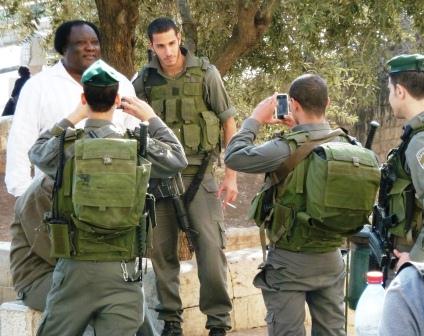
Here the tables were turned a little. One of our pastors, Ben, who is from Jamaica but pastoring in New York, is asked by IDF soldiers to pose with them. 


Unless the Lord builds the house,
its builders labor in vain.
Unless the Lord watches over the city,
the watchmen stand guard in vain.
(Psalm 127:1 - A Song of Ascents)

First View of the Holy City

We make the long drive up to Jerusalem. When they talk about "going up to Jerusalem" it makes a whole lot more sense to me now. It's a 4000 foot climb from the lowest point on earth to the most significant city on earth. No wonder there is a whole section in the psalms titled "Songs of Ascents" (Psalms 120-134) which recount going up to Jerusalem and the temple to worship God.

After going through a checkpoint with armed guards, we arive in the Holy City.


We drive up to Mt Scopus and this is the gorgeous scene before us:


Our guide breaks out the wine and leads us through a brief ceremony performed when one arrives in the Holy City. Kind of like communion. But no bread, and definitely no Jesus. Though when I look at the famous city for the first time, I can't help but think primarily of Him. We say a few Hebrew phrases. And look out on the city with awe.

Those who trust in the Lord are like Mount Zion,
which cannot be shaken but endures forever.
As the mountains surround Jerusalem,
so the Lord surrounds his people
both now and forevermore.
(Psalm 125:1,2 - A song of Ascents)

The Six Day War Restores the Western Wall of the Temple to Jews

IDF (Israeli Defense Forces) capture the temple area:

"Israeli officials flooded the city. It was a pilgrimage. Even the most worldly spoke of it in religious terms--how they stood before the Wall, which was covered in flowers, which was breathing, soft like skin, which was bleeding, wet with tears. A mad moment at the end of a mad age. Yitzhak Rabin wrote a prayer on a piece of paper and shoved it between the stones. Whoever does this is talking to history, worshipping the past. 'It was the peak of my life,' he said. 'For years I secretly harbored the dream that I might play a role in restoring the Western Wall to the Jewish people. Now that dream had come true, and I wondered why I, of all men, should be so privileged.' He gave a speech:

The sacrifices of our comrades have not been in vain. The countless generations of Jews murdered, martyred and massacred for the sake of Jerusalem say to you, Comfort yet, our people, console the mothers and fathers whose sacrifices have brought about redemption. - Rich Cohen, Israel is Real, 268.

I rejoiced with those who said to me,
'Let us go up to the house of the Lord.'
Our feet are standing in your gates, O Jerusalem.

Jerusalem is built like a city
that is closely compacted together.
That is where the tribes go up,
the tribes of the Lord,
to praise the name of the Lord
according to the statutes given to Israel.
There the thrones for judgment stand,
the thrones of the house of David.

Pray for the peace of Jerusalem:
'May those who love you be secure.
May there be peace within your walls
and security within your citadels.'
For the sake of my brothers and my friends,
I will say, 'Peace be within you.'
For the sake of the house of the Lord our God,
I will seek your prosperity.

- Psalm 122 - A Song of Ascents

The Six-Day War (which was actually a little longer)

In 1967, less than 20 years after the birth of the nation, President Nasser of Egypt said: "Our goal is clear--to wipe Israel off the map." Surrounded by the armies of three nations (Egypt, Jordan and Syria), and hung out to dry by her allies, Israel began to fight for her life in what was to be known as "The Six Day War."

"The phrase 'Six Day War' first appeared in The New York Times about two months later. The name, which is not properly descriptive--by most measures, the war laster more than a week--stuck because it echoed the holiest numbers in the Jewish lexicon: six days of creation, six million dead. The war was named like a TV show, with a demographic in mind: the Holocaust-haunted Jews of the world. It's a slogan: Six-Day War. It tells you that the story of modern Israel is the story of creation: something from nothing, desert in bloom--it's a miracle beyond normal history, so beyond question, so beyond doubt."
- Rich Cohen, Israel is Real, 269.

Masada

We spent Shabbat (the sabbath) at Masada and the Dead Sea. This shot is of the kosher kiwi admiring the latter from the former.

Herod's fortress was an impregnable palace which was taken over, long after his death, by Jews fleeing the Roman response to the Jewish rebellion of A.D. 66-70. After Titus demolished the temple in Jerusalem, some Jews escaped to Masada, and lived there from 70-73, when the Romans finally caught up with them.

The site is an astonishing 18-acre complex of palace, baths, storehouses, aqueducts, deep cisterns and soldier barracks atop a cliff top 1400 feet high. We got up there by cable car. The Roman army got up there by moving tons of dirt and building a ramp. It took them 3 years. You can see the remains of the Roman encampment in the little square in this aerial shot.

When they were finally able to take the fortress, they found 960 bodies. Rather than submit to rape and slavery or death at the hands of the Romans, they chose to take their own lives. The men killed their wives and children first, then each other. Two widows with five children somehow escaped the process and were found hiding in a cistern. It is through them that the account came to Flavius Josephus, the Jewish historian turned Roman army historian.

Our guide, who was in the IDF (Israeli Defense Forces) told us he was a driver seconded to the production of Masada, which is not historically accurate in every respect, but which I can't wait to see. Actor Peter O'Toole once told him, "Get my boots!" "Get your own ___ boots," our guide told him.
Published with Blogger-droid v1.6.5

Wednesday, January 19, 2011

Mt Carmel & The Valley of Megiddo

Then to Mount Carmel, where Elijah and his God had the famous showdown with Baal and his flunkies (that's Elijah with the knife, in case there's any confusion). I seem to recall Elijah saying something about toilets, but that was before Herod's time so we know that Baal did not use the one featured in the last post.

The challenge was made up on the mountain where a beautiful monastery now sits. "Let the competition begin!" Wow, to think it all happened, actually happened, right here. Kind of fitting, really since Mt Carmel overlooks the gorgeous, huge Jezreel Valley, the valley of Har Megiddo or Armageddon, where God's decisive end-time battle will be fought, and won.

As we are gazing on this awesome piece of real estate, F16s take off from a military runway we can see far in the distance. Our guide tells us that there are two in the air 24/7. Not that long ago the President of Iran was just north of here at the border with Lebanon, threatening again to push the jews into the sea.

Nachom, Our Guide

No sleep, but a great flight, and then we're on the bus with our Israeli tour guide. Though his quickness at blaming "those guys" for many things is initially a bit over the top, and the group stats to snicker whenever the words "violence" and "Arab" are used in close proximity, he turns out to be a superb guide with an encyclopaedic knowledge of Israel, history, geography and both Old and New Testaments. And I guess if I lived in a country that has gone through so many birth pains and growing up pains and was surrounded by folks who kept talking about pushing me into the sea, I might appear to have a little chip on my shoulder too. Here is Nachom drawing the layout of Roman roads on the Cesarea Hippodrome.

Published with Blogger-droid v1.6.5

Sunday, January 9, 2011

Skunk Juice & Barry Manilow

Last night was pizza night at the Blaikie household. One of the side effects of pizza can be a lively family discussion about something pristine or putrid. In this case, it was the latter. I had seen a Fox News segment about Israeli troops dispersing Palestinian protesters and stone-throwers with "skunk juice." One Fox reporter who got  baptized by it described it as "stuff that smells like raw sewage mixed with decomposing food. If the water gun hits you, the smell stays with you for several days."

            http://liveshots.blogs.foxnews.com/2011/01/07/skunk-water-and-tear-gas/

This unpleasantness reminded me of a TIME magazine article I read a number of years ago about how British police had come up with the ultimate technique in crowd dispersal for dark places frequented by teens up to thuggery and other mischief. They mounted indestructable speakers in high, inaccessible places and played Barry Manilow music. Loud. "Time for a music lesson, kids." A couple of clicks on youtube and we were listening to Barry crooning an old 80s favorite: "I write the songs of love and special things...I write the songs that make the young girls cry. I write the songs, I write the songs."

Not sure if Barry's songs would be enough to make the Palestinian men cry and disperse. Guessing the Israelis will stick with skunk juice and tear gas.